

Have you ever spent an entire evening trying to convince your partner that a harmless headache isn’t the start of a brain tumor? Or maybe you’ve watched someone you love withdraw because they’re tired of being treated like a walking medical emergency? If so, you aren’t alone. Health anxiety, often referred to as illness anxiety disorder or hypochondria, is more than just worrying about getting sick. It’s a persistent fear that you have a serious undiagnosed medical condition, despite little or no evidence from doctors. While this fear lives inside your head, its ripple effects crash into the people closest to you.
We often think of anxiety as a private struggle-a battle between you and your own thoughts. But when that anxiety centers on health, it becomes a relational issue. It changes how you communicate, how you spend time together, and how much emotional energy you can give versus take. Understanding this dynamic is the first step toward fixing it. Let’s look at exactly how health anxiety reshapes relationships and what you can do to restore balance.
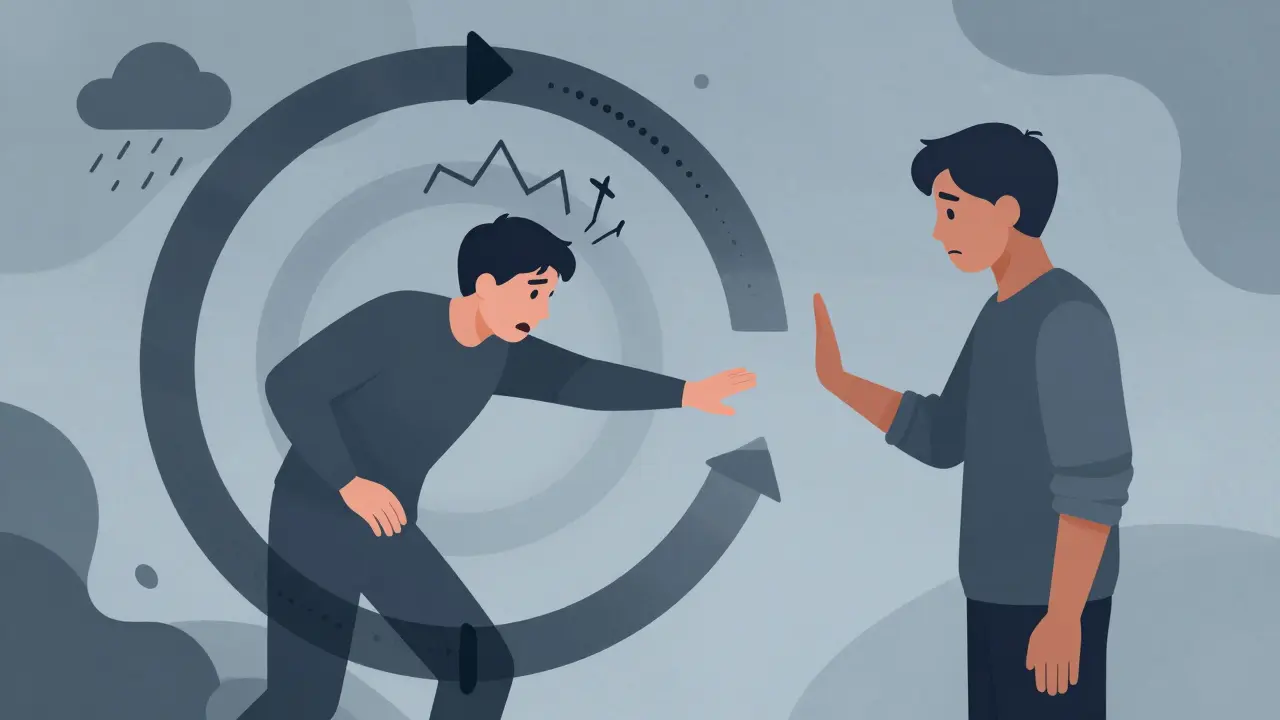
The Cycle of Reassurance Seeking
One of the most common behaviors in people with health anxiety is reassurance seeking. You feel a twinge in your chest, panic sets in, and you turn to your partner for comfort. "Does my skin look pale?" "Do I sound wheezy?" "What if this symptom means something terrible?" Initially, your partner might offer sympathy. They check your pulse, tell you it’s probably nothing, and hug you. For a few minutes, you feel better.
But here’s the trap: reassance provides only temporary relief. The anxiety returns, often stronger, because the root cause-the fear itself-was never addressed. Over time, this cycle wears down your partner. They stop seeing themselves as a supportive companion and start feeling like an unpaid therapist or a medical diagnostician. This shift creates resentment. Instead of intimacy, you get tension. Instead of connection, you get distance.
- The Trigger: A physical sensation (real or imagined) sparks fear.
- The Action: You seek validation from your partner or close friend.
- The Short-Term Relief: They reassure you, lowering your anxiety briefly.
- The Long-Term Cost: Your partner feels exhausted, trapped, or annoyed by the repetition.
This pattern doesn’t mean your partner loves you less. It means they are experiencing "compassion fatigue." When every conversation revolves around potential diseases, there’s little room left for joy, shared hobbies, or light-hearted banter. The relationship becomes defined by the anxiety rather than by who you both are.
Emotional Withdrawal and Isolation
As the pressure mounts, partners often respond by withdrawing. This isn’t always malicious; sometimes it’s a self-preservation tactic. If engaging with your fears leads to hours of debate, internet searches, or doctor visits, they may start avoiding these topics altogether. You might notice them giving short answers, changing the subject, or physically leaving the room when you mention symptoms.
This withdrawal hurts. To someone with health anxiety, silence can feel like abandonment. "If they don’t care enough to listen, does that mean my pain isn’t real?" This misinterpretation fuels more anxiety, which leads to more demands for attention, which causes further withdrawal. It’s a vicious loop.
Consider Sarah, a graphic designer from Brisbane who struggled with health anxiety after a minor scare with her heart rate. Her husband, Mark, initially supported her through numerous tests. But as months passed and all results came back normal, Mark began to disengage. He stopped asking how she felt each morning. He started working late to avoid dinner conversations about symptoms. Sarah interpreted this as him not caring about her well-being. In reality, Mark was burnt out. He didn’t know how to help without enabling the behavior that kept her stuck.
Impact on Intimacy and Physical Connection
Health anxiety doesn’t just affect talk; it affects touch. Physical intimacy requires vulnerability and presence. When your mind is scanning your body for signs of disease, it’s hard to be present in a moment of closeness. You might worry that a rash is contagious, that a slight ache indicates injury, or that your body image has changed due to perceived illness. These thoughts act as barriers to intimacy.
Partners also hesitate. If sex or cuddling triggers a discussion about symptoms, they may subconsciously avoid physical contact to prevent that conversation. Over time, this lack of touch erodes the bond. Touch releases oxytocin, the bonding hormone. Without it, couples feel more like roommates than romantic partners. The absence of physical affection reinforces feelings of loneliness, which ironically increases anxiety levels.
| Relationship Area | Common Behavior | Partner's Likely Reaction |
|---|---|---|
| Communication | Frequent symptom checking | Frustration or avoidance |
| Intimacy | Hypervigilance about body sensations | Withdrawal or hesitation |
| Shared Activities | Cancelling plans due to fear of exposure/sickness | Resentment over missed experiences |
| Decision Making | Insisting on unnecessary medical tests | Financial stress or conflict |
The Role of Catastrophizing in Conflict
Catastrophizing is a cognitive distortion where you jump to the worst-case scenario. A cough becomes pneumonia. A lump becomes cancer. When you share these catastrophic thoughts with your partner, they often try to logic their way out of it. "The doctor said it’s fine," they might say. But logic rarely wins against fear.
This mismatch in processing styles leads to conflict. Your partner wants facts; you need emotional safety. When they fail to provide the level of certainty you crave, you may accuse them of being dismissive or cold. They may accuse you of being irrational or controlling. Neither side feels heard. Arguments escalate quickly because the underlying issue-anxiety-isn’t being addressed directly. Instead, it’s disguised as a disagreement about medical opinions.
To break this, both parties need to recognize that the argument isn’t really about the symptom. It’s about the fear behind it. Acknowledging this shift can de-escalate tensions significantly.
Strategies for Partners: Setting Boundaries with Compassion
If you’re supporting someone with health anxiety, setting boundaries is crucial. This doesn’t mean shutting them out. It means defining what kind of support is helpful and what isn’t. Here’s how to approach it:
- Avoid Medical Debates: Agree beforehand that you won’t discuss symptoms beyond a certain point. If they ask for advice, gently redirect them to a professional.
- Validate Feelings, Not Fears: Say, "I can see you’re really scared right now," instead of "You’re going to be okay." Validation acknowledges emotion without confirming the false belief.
- Schedule "Worry Time": Designate a specific 10-minute window each day to discuss health concerns. Outside that window, other topics take priority. This contains the anxiety rather than letting it permeate the whole day.
- Encourage Professional Help: Gently suggest therapy, specifically Cognitive Behavioral Therapy (CBT), which is highly effective for health anxiety. Offer to help find resources, but don’t force it.
These boundaries protect your mental health while still showing care. They signal that you love them, but you won’t participate in the cycle of reassurance that keeps them stuck.

Steps for Those with Health Anxiety: Breaking the Pattern
If you’re the one struggling with health anxiety, taking responsibility for your healing is the best gift you can give your relationship. It’s not about suppressing your fears, but managing them differently.
- Limit Body Checking: Stop measuring your temperature, checking pulses, or searching symptoms online. Each check reinforces the neural pathway of fear.
- Practice Exposure: Gradually expose yourself to uncertainty. If you feel a strange sensation, sit with it for five minutes without acting on it. Notice that nothing bad happens.
- Communicate Needs Clearly: Tell your partner, "I’m feeling anxious, but I don’t need you to diagnose me. I just need a hug." Specific requests are easier to fulfill than vague emotional demands.
- Focus on Shared Joy: Actively plan activities that have nothing to do with health. Go for a hike, cook a meal, watch a comedy. Remind your brain that life exists outside of bodily sensations.
Remember, recovery isn’t linear. There will be bad days. On those days, lean on your therapist or support group, not just your partner. Distributing the emotional load prevents burnout in the relationship.
When to Seek Professional Intervention
Sometimes, self-help strategies aren’t enough. If health anxiety is causing frequent arguments, leading to separation, or resulting in depression, it’s time to involve professionals. Couples counseling can help rebuild trust and improve communication patterns. Individual therapy, particularly CBT or Acceptance and Commitment Therapy (ACT), addresses the core anxiety mechanisms.
In Australia, organizations like Beyond Blue or local GP referrals can connect you with specialists. Many psychologists offer telehealth services, making access easier even if you’re hesitant to leave home. Early intervention prevents long-term damage to the relationship structure.
Is health anxiety the same as having a chronic illness?
No. People with chronic illnesses deal with real, diagnosed conditions. Health anxiety involves intense fear of having a serious illness despite medical evidence showing otherwise. However, some people may have both a chronic condition and health anxiety, which complicates treatment.
Can health anxiety be cured?
While "cure" implies permanent elimination, health anxiety can be effectively managed. With therapy like CBT, many people reduce their symptoms significantly, allowing them to live full, connected lives without constant fear dominating their actions.
Why do doctors sometimes dismiss health anxiety patients?
Doctors are trained to treat physical pathology. When tests come back normal repeatedly, they may feel frustrated or unsure how to help. This isn’t necessarily malice, but a gap in training regarding psychological aspects of health fears. Finding a provider experienced in psychosomatic issues helps.
How can I support my partner without enabling their anxiety?
Support by listening empathetically but refusing to engage in diagnostic debates. Validate their fear ("I see you're scared") without validating the conclusion ("Yes, it could be cancer"). Encourage professional help and maintain healthy boundaries around topic discussions.
Does health anxiety get worse over time?
Without treatment, yes. The brain learns that checking and worrying provide temporary relief, reinforcing the behavior. Over years, this can lead to increased isolation, relationship breakdowns, and secondary mental health issues like depression. Early intervention stops this progression.